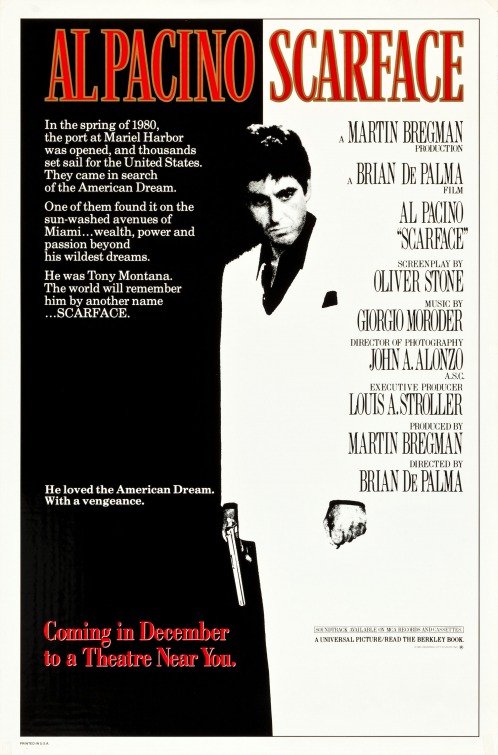
 Brian De Palma’s Scarface is like an inverse Godfather. The movie is semi-epic – a dry cartoon of the American dream gone numb. But (and this may stem from the nature of the gangsters involved), it lacks the broad elegance of Coppola’s auspicious rendering of Mario Puzo’s potboiler. And the original Scarface (1932, dir. Howard Hawks) is much more efficient, almost brutally so.
De Palma’s Scarface spins to the rhythms of disco and coke. Tuned to a fast-then-slow delirium, one with which Tony Montana (Al Pacino) becomes the King of Miami, the movie is a jagged comedy. (You could call it spixploitation.) Uber-excess is the point; obsessive vulgarity bears a Zen-like commitment to itself. And there’s an orchestrated, almost musical feel to the way the actors move and talk. They bop the movie along. Normally, you rate a De Palma film by the extent to which the set-pieces gel. Here, Oliver Stone’s dialogue is the glue, and De Palma scales the film to its hero – the swagger, the flash, the bloodsport. We follow him down the line. (For some viewers, this Scarface may have been the first gangster film that caused them to laugh nervously, to dine on dread from which there was almost no moral relief.) In the lumpy midsection, De Palma’s film grinds to a near-halt. The tempo drags; Tony’s code of honor goes to rot. The coda, though, is perfect — a balls-to-the-wall slaughter.
As with Jack Nicholson’s kabuki-like performance in The Shining, Pacino strikes a rare sort of awe, one that has fueled his career since. Never mind that he outdoes Paul Muni: He even manages to top Jimmy Cagney’s sign-off from the top of the world (White Heat, 1949).
Fun.