As a non-musician, Eno is good at thinking outside the box. He strives for beauty, and takes himself lightly. He is also open to chance.
What a guy.
Occasionally, though, these traits are hard to hear. Witness My Life in the Bush of Ghosts (1981), his flat collab with David Byrne, or parts of the Ambient series from 1978 on. His foregrounded approach to making background music toes the line between melody and theory. It’s risky. Usually, be they dream-scapes or drone-scapes (or both), his music is tuneful, and he makes you think about the true meaning of “ambient.” So in Eno’s universe, sound is all; and the studio is his dominant instrument. Seen as props (which by themselves signify little), the rock & roll signatures of his pop phase are no less ambient. He creates worlds which we can easily project onto.
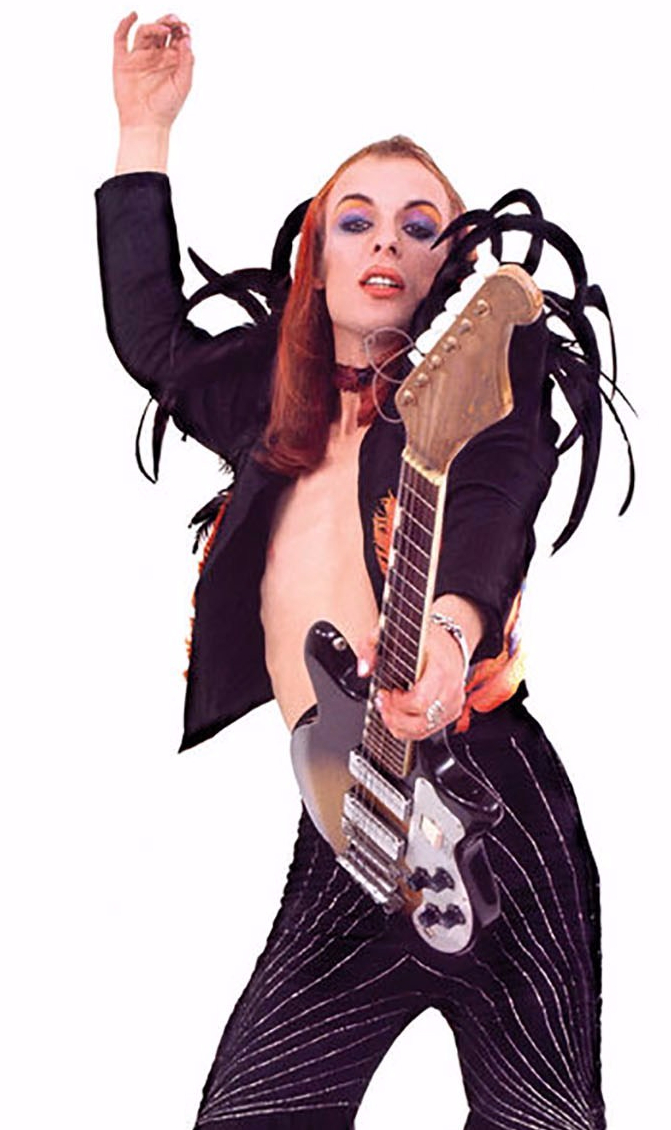
Here Come the Warm Jets (1974) is the cheekiest Eno. Back in Roxy Music, when he “treated” instruments on a synthesizer, wore eye-liner and generally stole the show, Eno was enamored of body music (i.e., dirty sound). A distillation of a distillation, Roxy was all the elements that made rock “roll”: noise, sex, boyishness, weirdness. Presence.
And the beat. Always that beat.
Warm Jets expands the Roxy brand. Because it burst right after For Your Pleasure, and most of the same hands are on deck, it really is Roxy sans Bryan Ferry. Small choices add up: Lyrics are naughty-sneaky — Seuss-like in their brevity, their imagistic nonsense — and Eno’s singing is almost willfully undisguised, the voice of a nerdy white guy with no character to play or singer to mimic. He sings mostly to complement the wall of sound; and it sounds like he’s having fun. Also, Robert Fripp skronks some of the most mind-blowing guitar this side of Lou Reed. Because of how tribal it is — because he is less Euro-dramatic and more conspicuously human as a result — Eno’s debut tops the first two Roxy albums. It’s killer-diller. A
Jets part two is Taking Tiger Mountain (By Strategy) (1974), minus Fripp. There are fewer hooks, and some of Eno’s repetitions bore; but the record is dichotomous, dark, and dissonant, in ways that continue to unfurl. “Back In Judy’s Jungle” is the “Colonel Bogey March” on acid. “Third Uncle” skates on rails. B
Arguably, Another Green World (1975) is the peak in his egg-headed marriage to mood music. Each little sound collage is sculpted just so. The balance of textures is fluid, light, and ominous; never does it feel synthetic or strained. There is a real sense of warmth and space here; the track list breathes. And it feels linear somehow — but scratch the number of times you’ve heard the record in full. Each subsequent track still sneaks up on you.
In terms of his oeuvre, Green World is singular for the manner in which it co-opts pop. Any normal associations we may have with song structure are tweaked a-new; rhyme, meter and shift are tugged, gently. It’s a transitional record, a door to the abstract. And its main selling point is, in my view, its chief limitation. There are days when I long for extended versions of “Spirits Drifting” and “The Big Ship,” when the self-imposed brevity (the self-imposed pop format, you could say) seems a bit rigid.1 No matter. For all its novelty (at the time of its release, anyhow), Green World remains his friendliest, most accessible long-player. A+
Before and After Science: Ten Pictures (1977) is the first Eno-does-Eno album. Psyched, perhaps, by stuff he had done (Another Green World, in particular), and a wee bit scattered, Eno seems to have outgrown the material here. He might be a perfectionist, but it’s just as likely he was not able to discard the tapes in progress, and released them for public consumption simply to be rid of the whole affair.2 If his whole shtick is to loop-and-group –- merging tracks, letting accidents happen, and sequencing sequences until he’s arrived at something –- Science, due to its clinical disjointedness (a side more pop and a distinct lack of flow all around), is the most translucent example of his process. “King’s Lead Hat” and “Julie With…” are sublime, but most of the rest of the tracks pale. Filler acts less as interlude and connective and more as filler. (These bits might have fared better in context on a Music For Films blotter.) The album fascinates, but it does not sing. Serving up genius is hard work. B-

1Between Another Green World and Discreet Music (another benchmark that year and the longest, prettiest fog horn I’ve ever heard), I may prefer the latter. It is a different beast, though; which means that, with so much choice Eno to consider, ranking his albums is kind of silly.