John Carpenter is a simple director. That is why he is revered, and why some people write him off. His films don’t apologize for themselves, and they don’t fall back on weak-ass metaphor. They are what they are, and that is enough.
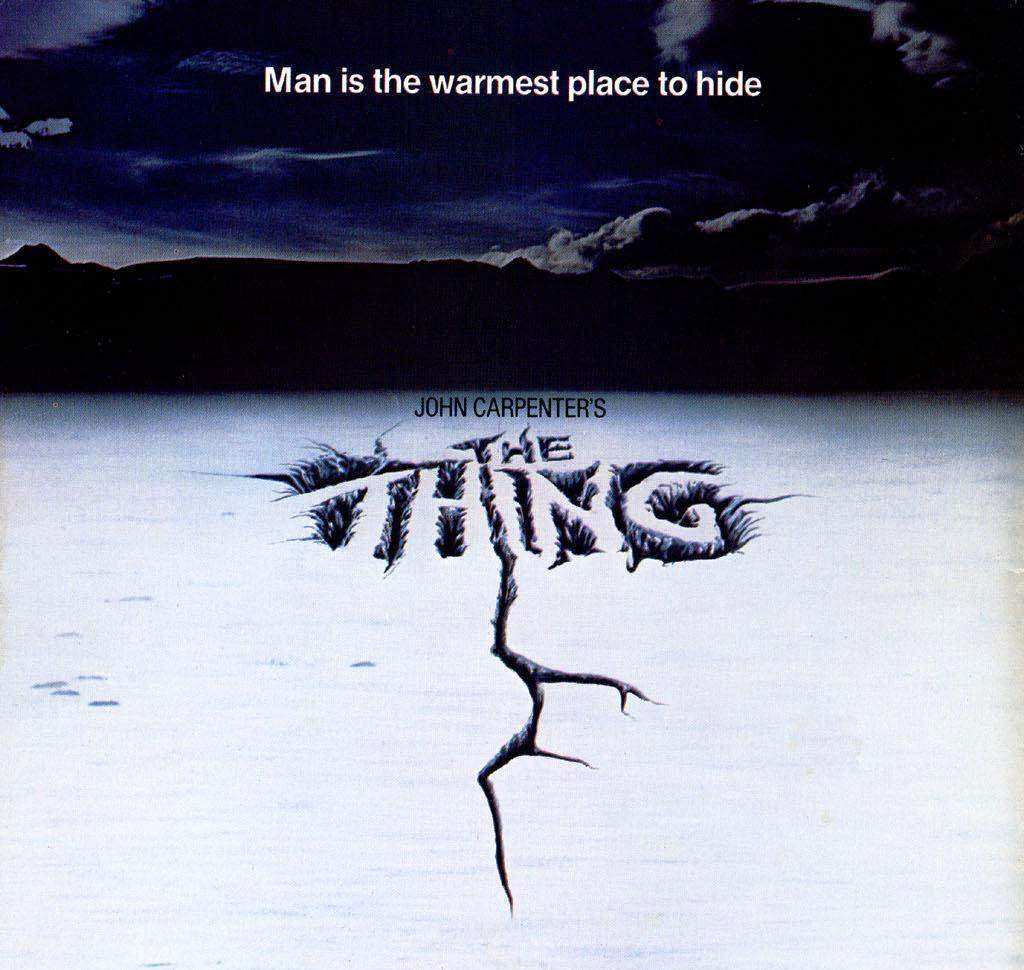
Looking at the man’s career, you see a shift from the concise to the explicit. The Thing, though, is not just a gross-out. It is arguably the benchmark of modern horror cinema. The special effects are nauseating but they do not undermine the film. Rather, they grow out of the story, one that is shaded by subtlety and a palpable sense of dread.
Not everything is spelt out. Playing on the theme of seen-and-unseen, the film stokes atmosphere long before the “Thing” starts spewing. When the dog roams the hall, there is a character there, and you realize that the FX add a dimension of feeling, not a substitute for the assumed lack of imagination.
Carpenter is a pro. To say The Thing is reviled only shows he is misunderstood. What with the care and personal authorship his films have, and the non-imposing sense of humor (movie in-jokes, for example), he is quite cinematic. And, by sticking close to the trends in horror that he helped pioneer, he runs the risk of being tagged with the crap that rips him off.
To most critics who are basic reactionaries (i.e., pea-brained pontificators), the fact that horror is a genre of emotion, not intellect, marks Carpenter as something less than a director. In their eyes, genre limits the occurrence of art — it is “rote.” They fail to see its canvas as a launching pad for the muse. Thus a surfeit of special-FX horror films clouds the issue, and the greatness, of The Thing. Like The Exorcist and Alien before it, the movie plays on the universal fear of icky stuff — jellied mess. It projects the ultimate fear of (non-)conformity; how this fear prompts humans to punish each other in ways that are horribly violent. In short, The Thing is more than a gob of goo. Special FX do not a good movie make, but critics were off to dismiss Carpenter’s film, anyway.
The gore for The Thing is so disgusting that it one-upped the teen-slasher phenom Carpenter made: Halloween. Yet that film was The Thing in disguise — it was always going to lead to it. The Thing is a tricky synthesis, but Carpenter did it, mixing the bloodless style of terror in Halloween with the graphic kind given to the Halloween takeoffs (e.g., Prom Night, Terror Train, and Friday the 13th). For better or worse, Carpenter did not turn back. He hasn’t made a great film since.
*
When a film shakes us, bugging our deepest fears and desires, some of us cannot be made to defend it. We feel violated; we weren’t ready. From about 1976-1982, John Carpenter was ingenious. His paucity of budget and time forced him to find new ways to get viewers on the edge of their seats. If The Thing was a peak, ingredients came out of films he had made previous, Halloween in particular. It’s a stunning movie, and scary as heck.
Halloween is great because it is simple. Made in twenty days for $300K, the movie has one purpose: to scare. Compared to the spawn of imitators, it works because it is committed to the economy of craft. Carpenter had drive and imagination; the rip-offs don’t. Trying in vain to repeat the success of Halloween, they show a lack of respect for (and knowledge of) fear. Over-dependence on the Halloween patent is a disregard for genre, and for film in general.
Because it seems as if everything is on the surface, the film may appear one-dimensional when in fact it is streamlined. It visualizes the mental. Just as Carpenter’s work is a bunch of riffs on the same theme(s), Halloween is a round of jolts. The sequencing is the trick. Certain parts may drag, but only because they don’t have the shock of the new. The movie is short, but it takes time to build suspense.
Part of why the movie works is due to the mundane setting (Haddonfield, a suburb), and the brevity of character (it verges on the archetypal, but avoids cliche as it captures the way teenagers interact). Also, the movie is set mostly at night. That, and the fact that Haddonfield is semi-deserted, makes you feel enclosed and isolated — along with Laurie the babysitter (Jamie Lee Curtis). (Every kid in America knows what a babysitter is.) We also see and hear The Thing (1951) and Forbidden Planet on TV. In small degrees, this makes what we’re watching — Halloween — seem more real and less like a movie.
We like Laurie because she wants to be good. She’s not completely noble, but she doesn’t want to get in trouble. She’s awkward and busty, goofy but shy. The way Curtis plays her, Laurie is afraid of her sex.
When Michael Myers attacks, it is the most destructive rage, but machine-like. He doesn’t talk — he just breathes. He might be “The Shape” of Laurie’s dark side run amok, but it’s hard to make out who he is — what he signifies, why he does what he does. He is scary, though. He’s scary because he defies reason. Nonstop and bigger-than-life, Michael is an out-sized child. Stylish turns of the death toll hang on that disconnect between strength and mental imbalance. Why does this man, this impenetrable force of evil, go after Laurie, a protector of children? Did the grown-ups in his life do something to him, something bad?
Other Halloween films provide motive. (Pathetically, Halloween Resurrection wants to update the formula with the look and feel of The Blair Witch Project, which [if any film did] made the former obsolete.) Carpenter explains nothing. In Halloween scams like Friday the 13th and Valentine, the killer’s mask is a gimmick. For Michael, the mask and the knife are more than just random props. They tie him to the past; they convey a sense of guilt; they depersonalize him. My friend, Kent Conrad, said it best: “Look at the scene where Laurie tears the mask off. Instead of trying to kill her, Michael takes the time to put it back on. He’s frightening because he has purposely become an animal. He doesn’t just kill; he has destroyed the thing in himself that has the potential to be human.”
The real villain of the film is evil — or, to be more precise, the Panaglide. With the score’s aid, the cam stalks, surprises, and kills the people onscreen. (J.C.’s camera is close — strategically close. It’s almost unbearably tight. In Christine, a whole character [the car] is defined by mise en scene.) It forces identification; it makes you complicit. That is the coup of Carpenter’s technique. Directors like Bava, Hitchcock, Powell, and Argento (let us not forget De Palma) play with POV, but Carpenter brought the voyeurism and the subjectivity to the fore. He made it the lynchpin of the movie. Some people thought he was too kinetic in the way he set out to shock, too single-minded. But he got the effect he wanted, and that’s all that matters.
Remember: in terms of Carpenter’s career, Halloween has precedent. Most J.C. films depict a siege by tangible ghosts. Starman deals with a young widow who has been kidnapped by an alien, one that has taken on the image and likeness of her dead husband. (The sweet-Jesus liberalism is goopy and smooth.) Dark Star is equally hippie, but the stoner antidote to Starman. It shows a crew of astronauts besieged with boredom, one made manifest by the deep space they plumb. (Carpenter called it “one big optical Waiting for Godot.”)
Both The Fog and Assault on Precinct 13 carry the trend.
*
Q: What made the early films so good?
A: Broadly speaking, four things.
1. They came at a time when the age of the director, the 60s and 70s, gave way to the blockbuster mindset of today. They were caught between two Hollywoods — the arthouse and the megaplex — without falling prey to the excesses of either. They drew from and appealed to both crowds.
2. J.C. was best when the smallness of his budgets complemented the smallness of his films. It forced him to be resourceful; he was more inventive. So, because they were cheap, his films had to be suggestive. That’s why some of the earlier movies hold up.
3. His films were collaborative in the best sense of the word. The crew was hungry. Everyone pushed each other. They had nothing to lose and everything to gain.
4. Debra Hill?
The first generation of film school students — J.C., Lucas, Coppola, De Palma… — loved foreign films and had an abiding love of the serial. For the most part, J.C. has remained true to his roots.
However, bigger budgets mar his simple aesthetic. Take Ghosts of Mars, which is a retread of Assault on Precinct 13 and Prince of Darkness. The old joy and wit is gone. Long on synthesized heavy metal, the soundtrack sports too many frills. Carpenter’s soundtracks used to be a few notes and a simple motif. Now he’s fattened a minimalist formula. More and more, he belabors the point…
And now he’s pretty much retired, occasionally touring the world with his son, playing all those wonderful themes he wrote over the course of his career. Every so often, you can spot him in a low-grade interview about horror, or being feted after a screening of one of his films. I think he’s done being angry at Hollywood, at the state of cinema in general. If I had to guess, I’d say he’s mellowed a bit, acknowledging it was a wonder he was even able to make all those mid-level horror films for as long as he did.
Roll on, John.