
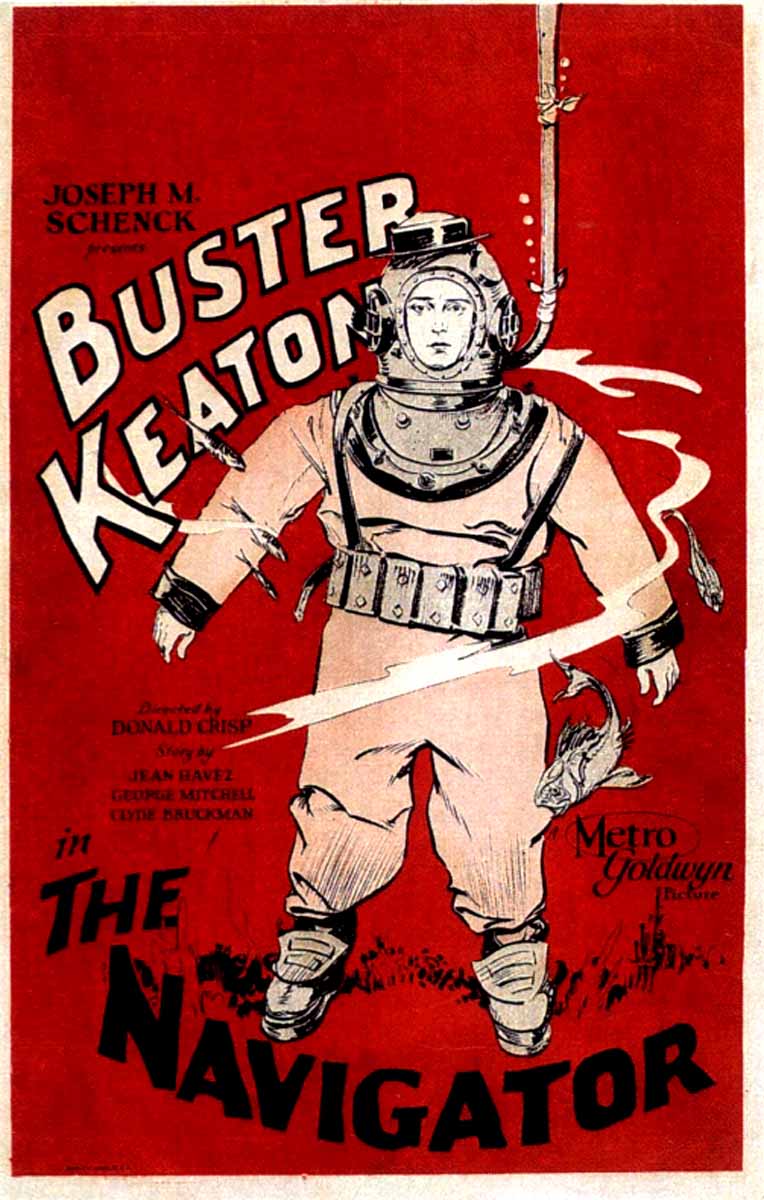
 The Navigator is great comedy. Buster Keaton and Kathryn McGuire play a young rich couple cast adrift on a deserted ocean liner. Never having to fend for themselves before, they must suddenly think about survival. They must learn to accept the technology that webs them: Noticing supplies have been stored in mammoth size, they set up a mad pulley system with which to do their cooking, and sleep on makeshift beds in the steam rooms of the ship.
Taking the mollycoddles out of their natural space allows Keaton to send up their helpless naivete. Yet it remains doubtful whether these characters mature. Perhaps this is as it should be. Keaton, lean surrealist that he is, keeps both the viewer and the character locked in tittering suspense. In a world of perpetual (if slight) imbalance, as flukes and near-misses occur with unanticipated regularity, any sense is nonsense (sort of what historians call the “Keaton Curve”).
Keaton never lingers on a moment, a single object. Neither his cinematography nor his editing feels rushed. The prop-scattered premise is such that anything more than a modest amount of directorial technique would sap our enjoyment. So, he allows the anarchic absurdity of the conflict to unfold with seeming naturalness.
Craft here is outlandish and concise, persona and plot cleanly interwoven. The elements merge into an utterly clipped and distinct style.
A counterbalance between an even presentation of a skewed universe, The Navigator is full of spontaneous amusements. On the one hand, it’s a vehicle for the stone-faced Keaton: plucky but luckless boy-man pratfalling between a strong, comely gal-pal and gag-induced props. Seemingly stoic, Keaton pops with acrobatic verve — the sweet, sustained likability of a housebroken pet. And, by isolating these hapless tots among props simply shot — and ridiculously over-sized props of an even bigger one (the “Navigator” ship itself) — Keaton’s cinema becomes one of trim surrealism. Added to obsessive inattention (another trademark), hilarity soars.
This is a film whose concrete trappings fit an on-screen persona. Said persona embodies the conflict between humanness (clumsy folly) and a lack thereof (graceful perfection). It shows Keaton’s flair for economizing into live action a tangled, fresh paradox. As shown in films like Steamboat Bill, Jr. (1928), The General (1927), and Sherlock, Jr. (1924), an impulsive fondness toward man and machine alike makes Keaton’s body of work feel refreshingly modern. His semi-detached surrealism allows us to partake of his humanity, and to purge ourselves of any illusions we might have had about it through laughter.
The Navigator was Keaton’s most profitable silent film. It only suffers inasmuch as his two-reelers are riotously funnier, and the other feature-lengths much more clever. On the whole, though, Buster transcends the medium, and this is a near-timeless work of art.