
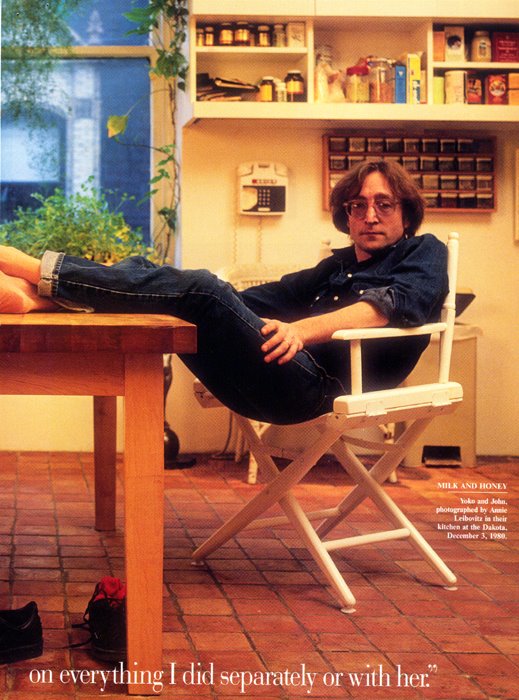
Last night I dreamt about John Lennon. I was in a crowded theater, waiting for The Beatles to reunite onstage after close to 50 years. John was alive, and the group was finally going to play. I knew I was dreaming. But there they were, necktied and respectably older, doing all the old stuff: solo tunes, group tunes — the whole shebang. The set was lively, loose, and fun. John, in particular, looked great — optimal John, you could say. And I found it apt that he would slow the show down in the middle and engage the audience in a banter, which the band funneled into pop bits created on the spot. I loved it. Looking about, I saw kids clapping, young and old, smiling and enjoying themselves. I was a kid, too, and how appropriate: John always wrote for the inner child. A crazy dream? Yeah, but I loved every second of it…
I don’t know if John Lennon was a genius. I don’t know if he was a nice guy. But I do know he was a great singer, and his music means a lot to millions of people, myself included.
And I find it hard to write about The Beatles. To do so would be silly and redundant — we all know how great they were.
Sgt. Pepper’s Lonely Hearts Club Band is a marvelous album, and why? It encapsulates everything great about art and music and bullshit. In breaking free the conventions of music, it killed rock & roll. That’s a big claim for anyone to make, but there you go.

Rock & roll is never just what it is (things rarely are). At its best, rock & roll is among the finest, most expressive and direct means of communication. And now that it’s been historicized to death, we can safely say that this music is first and foremost about pain (with pleasure not too far behind).
This is not to say that rock & roll (never just “rock”) cannot work simply as entertainment. Much of its longevity is down to the wily shenanigans of businessmen and art school types (and kids on the street/in the ‘burbs, bored out of their minds). But if we are to take rock & roll seriously, and at more than just face value, we mustn’t lose sight of its base in the blues.
Certainly, we are talking about more than just identity politics here. We are talking about hurt.
John was a talent who, like Hitler before him, came out of a bad family situation. Am I being simplistic? Perhaps. But it’s hard to deny or put aside all the creativity that came from that pain, and it’s hard not to trace such an outgrowth to the way it developed.1

Whether possessed or observed, genius is an elusive property. After all, what do we really know about this bandied word? We know it’s not a vacuum; that it takes genius to recognize genius, let alone show it. Life, then, is about other people. To get things done, we cannot simply (re-)produce by our own selves. We have to help each other out with our respective loads.
“The daisy chain makes it plain that we’re all just yin and yang.” There would be no Pet Sounds without Phil Spector, no Citizen Kane without German expressionism. Had Lou Reed been unashamed about who he was and what his parents wanted him to be, the mad repetitions of “Sister Ray” would never exist. The cost of living is the price of poetry and all subsequent liberation. In a sense, we’re all capable of genius. We just have to eat slop and ask for more, especially when preaching about love and law. We have to sacrifice, and we have to do it together. That’s not cynical, and that’s not philosophical. That’s life.
So John was this and John was that. To pick one over the other is meaningless and fair. Like John, I prefer the “truth,” and the idea that truth is bunk and never entirely honest. As long as we’re upfront about it, and true to ourselves, being a dreamer is OK. Because it’s rock & roll, and rock & roll is real, the core message of Lennon’s music2 (if there is one) is that we owe it to ourselves to live life fully, to fill in as much of the canvas as possible, and to just sort of play it.
In the end, John was only John, I am only Jack, and you are only you. We are the eggmen, and we can only be ourselves.
1Sometimes I wonder if one’s celebrity (or dramatic world-changing) is not the result of that person’s bruised ego. John’s anger was apparently big enough that the whole world heard it, and still does. All that pain comes busting out, so much so that the amplified artist is with us forever, now that the lengths of his isolation have spread to win the hearts of many. That, I think, is a wonderful way of finding out just how loved each one of us really is.
Though it may be hard to see, we all have someone who loves us, right?
Anyway, all we can do is be.
2Or, for that matter, Kiss — the band.